


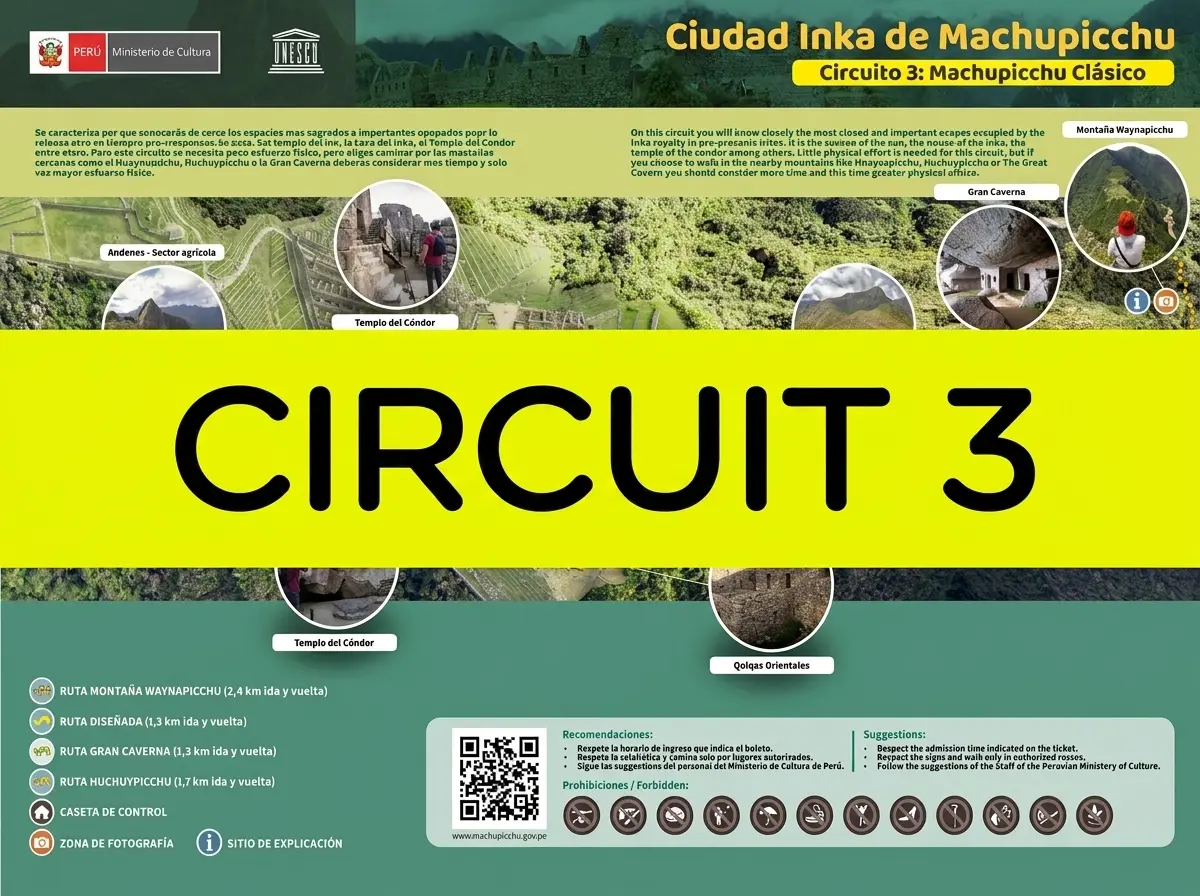
Machu Picchu Circuit 3, officially known as the Royalty Circuit, mainly covers the lower sectors and part of the urban sector of the Inca city. Along the way, you can discover important ceremonial, residential and architectural areas, including the Temple of the Sun, Inka House, Water Fountains, Temple of the Condor and Water Mirrors.
This circuit also offers four different experiences: Route 3-A, which includes Waynapicchu Mountain (Huayna Picchu); Route 3-B, known as the Designed Route; Route 3-C, which leads to the Great Cavern; and Route 3-D, which includes Huchuypicchu Mountain.
Each route has different characteristics, levels of physical effort and maximum visiting times. In this guide, you will learn what each route includes, its difficulty, when it is available and which option may be best for your visit.
1. What is Machu Picchu Circuit 3?
Machu Picchu Circuit 3, officially called the Royalty Circuit, is one of the three main visitor circuits established to organize visits to the archaeological site.
Unlike Circuit 1, which is primarily focused on panoramic experiences, and Circuit 2, which allows visitors to explore a larger number of archaeological sectors within the citadel, Circuit 3 mainly focuses on the lower sectors and important areas of Machupicchu’s urban sector.
The circuit allows visitors to discover places of great archaeological importance, including the Temple of the Sun, Inka House, Water Fountains, Twelve Openings, Water Mirrors and Temple of the Condor, depending on the route selected.
One of the main characteristics of Circuit 3 is that some of its routes allow visitors to add mountain experiences:
- Route 3-A: Waynapicchu Mountain.
- Route 3-B: Designed Route.
- Route 3-C: Great Cavern.
- Route 3-D: Huchuypicchu Mountain.
For this reason, Circuit 3 can accommodate both travelers looking for a relatively relaxed archaeological visit and those who want to add a mountain hike to their experience.
2. What does Machu Picchu Circuit 3 include?
The exact places you will visit depend on the route indicated on your ticket. However, the different Circuit 3 routes allow visitors to explore important areas of the Inca city.
Among the places that may form part of these routes are:
Temple of the Sun
This is one of the most important ceremonial structures at Machupicchu. It features a semicircular construction built over a natural rock formation and is notable for the precision of its architecture.
The interior of the temple is not part of a conventional unrestricted visit, so visitors must follow the designated route and respect access restrictions.
Inka House
This is an architectural complex located in the urban sector of Machupicchu. Its exact function has been subject to different archaeological interpretations and it has traditionally been associated with residential spaces of high status.
Water Fountains
Machupicchu has an impressive system of channels and fountains that uses water from natural springs. These structures played an important role in supplying water to the city.
Twelve Openings
This is one of the architectural complexes found along the Circuit 3 routes. Its stonework demonstrates the precision characteristic of Inca construction.
Water Mirrors
This area is part of Machupicchu’s urban sector and stands out for its stone structures and its relationship with activities carried out within the city.
Temple of the Condor
This is one of the most distinctive structures at Machupicchu. The Incas incorporated a natural rock formation with carefully worked stone elements to create a composition resembling the shape of a condor.
Pisonay Plaza
Pisonay Plaza appears on the official maps of some Circuit 3 routes and is another important space within the urban sector of Machupicchu.
3. What does Machu Picchu Circuit 3 NOT include?
It is important to understand the limitations of the circuit before purchasing your ticket.
Circuit 3 is not the circuit primarily designed for the classic panoramic Machu Picchu experience from the upper part of the archaeological site.
If your main priority is obtaining the traditional panoramic views of the citadel, you should consider the available options within Circuit 1.
On the other hand, if you want to explore a broader selection of the main archaeological sectors of Machupicchu, Circuit 2 may be a more suitable alternative.
You should also keep in mind that not every Circuit 3 route includes a mountain. To climb Waynapicchu, you must specifically purchase Route 3-A, while access to Huchuypicchu corresponds to Route 3-D.
If you want to visit the Great Cavern, you must select Route 3-C when it is available.
4. Route 3-A: Waynapicchu Mountain
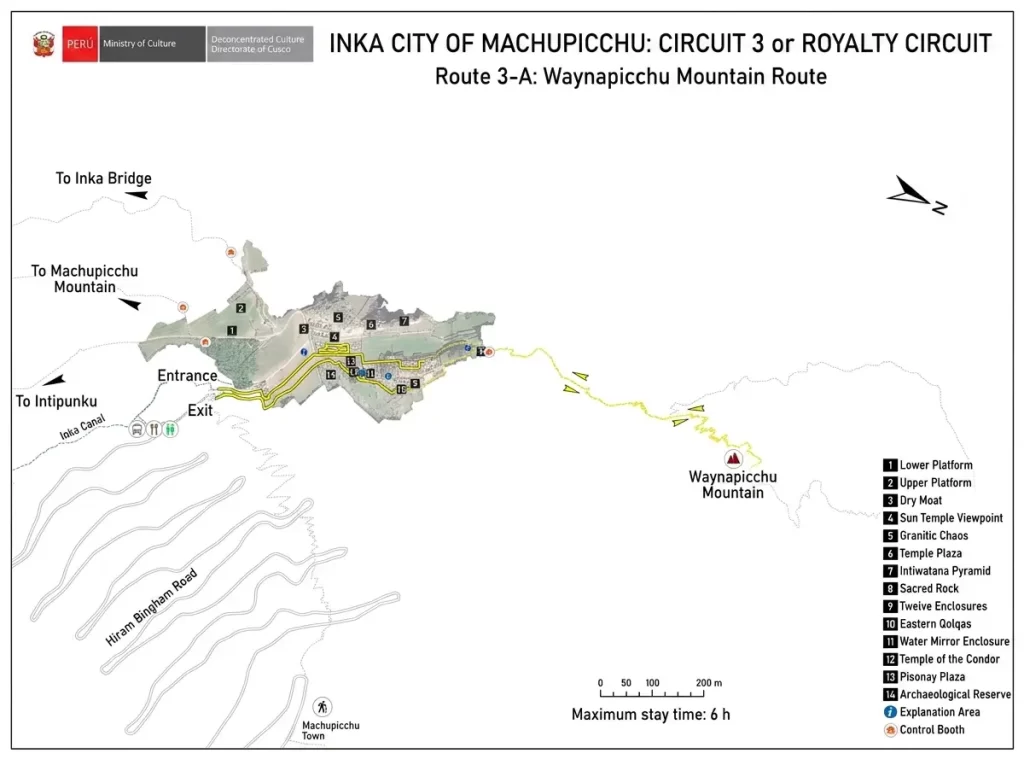
Route 3-A combines the visit to Machupicchu with the ascent of Waynapicchu Mountain, internationally known as Huayna Picchu.
Waynapicchu is the mountain that appears behind the citadel in many of the most famous photographs of Machu Picchu. The ascent takes place along a mountain trail with stone stairways, steep slopes and some narrow sections.
What does Route 3-A offer?
The main attraction is the experience of climbing Waynapicchu and viewing Machupicchu from an elevated perspective.
Along the trail, you will encounter lush vegetation characteristic of the cloud-forest environment and various archaeological structures and features associated with the mountain.
Difficulty
High.
The ascent requires considerable physical effort. The stone stairways can be steep, and some sections of the trail may become slippery when wet.
There is no need to rush the climb. It is best to maintain a steady pace, wear suitable footwear and follow all safety instructions.
Maximum visiting time
The complete Route 3-A experience combines the visit to Machupicchu with Waynapicchu Mountain and can take several hours.
The maximum visiting time established for this experience is up to 6 hours, according to the applicable regulations.
The actual time required to ascend and descend depends on each visitor’s pace, physical condition and trail conditions.
Availability
Route 3-A is one of the regular Circuit 3 routes, with availability subject to the schedules and quotas established for ticket sales.
Who is it recommended for?
It is a good option for:
- Active travelers.
- Hiking and mountain enthusiasts.
- Visitors who specifically want to climb Waynapicchu.
- Photographers and travelers interested in different perspectives of Machupicchu.
If climbing Waynapicchu is your main priority, it is advisable to book as far in advance as possible because the number of spaces is limited.
5. Route 3-B: Designed Route
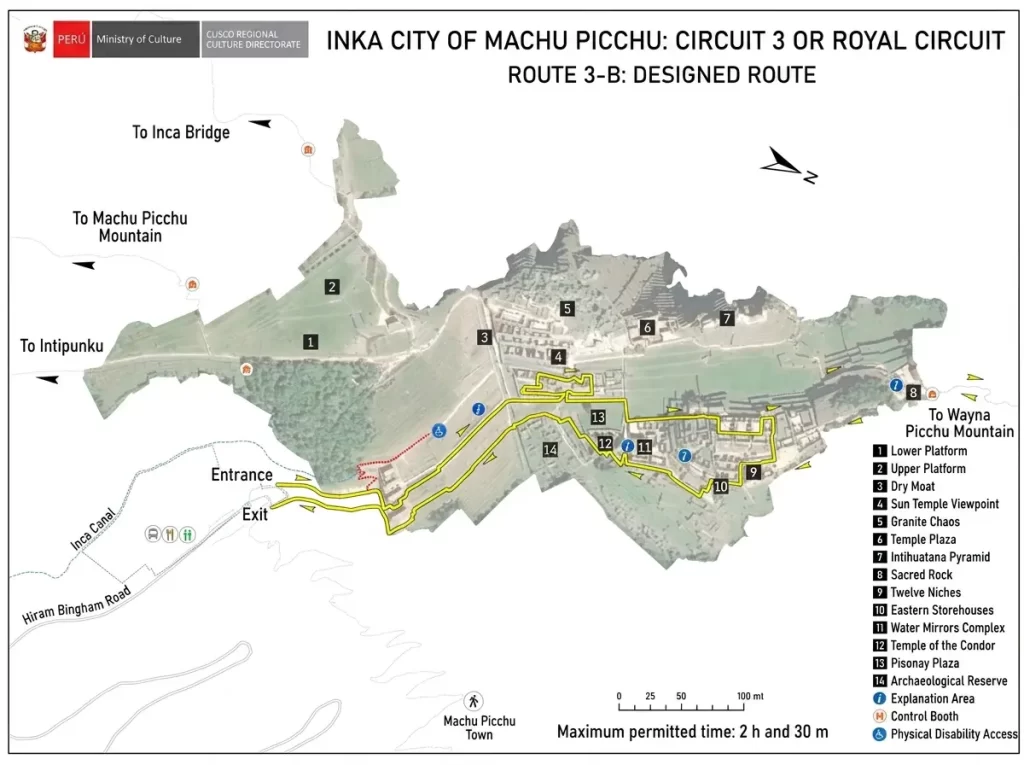
Route 3-B, officially known as the Designed Route, is the more relaxed option within Circuit 3.
It does not include a mountain climb such as Waynapicchu or Huchuypicchu. Instead, it allows visitors to explore different areas of Machupicchu’s urban sector through a designated archaeological route.
What can you see?
Depending on the established route, Route 3-B includes areas such as:
- Temple Plaza.
- Intiwatana Pyramid.
- Sacred Rock.
- Twelve Openings.
- Eastern Qolqas.
- Water Mirrors.
- Temple of the Condor.
- Pisonay Plaza.
Difficulty
Low to moderate.
Although it does not include a mountain hike, visitors still need to walk over uneven terrain, stone stairways and other archaeological surfaces.
Therefore, it should not be considered a completely flat route.
Maximum visiting time
The maximum visiting time established for this route is 2 hours and 30 minutes.
Who is it recommended for?
Route 3-B can be a good option for:
- Travelers who do not want to climb a mountain.
- Families looking for a more relaxed visit.
- People who prefer to focus on architecture and archaeology.
- Visitors with limited time.
- Travelers who were unable to obtain a mountain-route ticket.
6. Route 3-C: Great Cavern
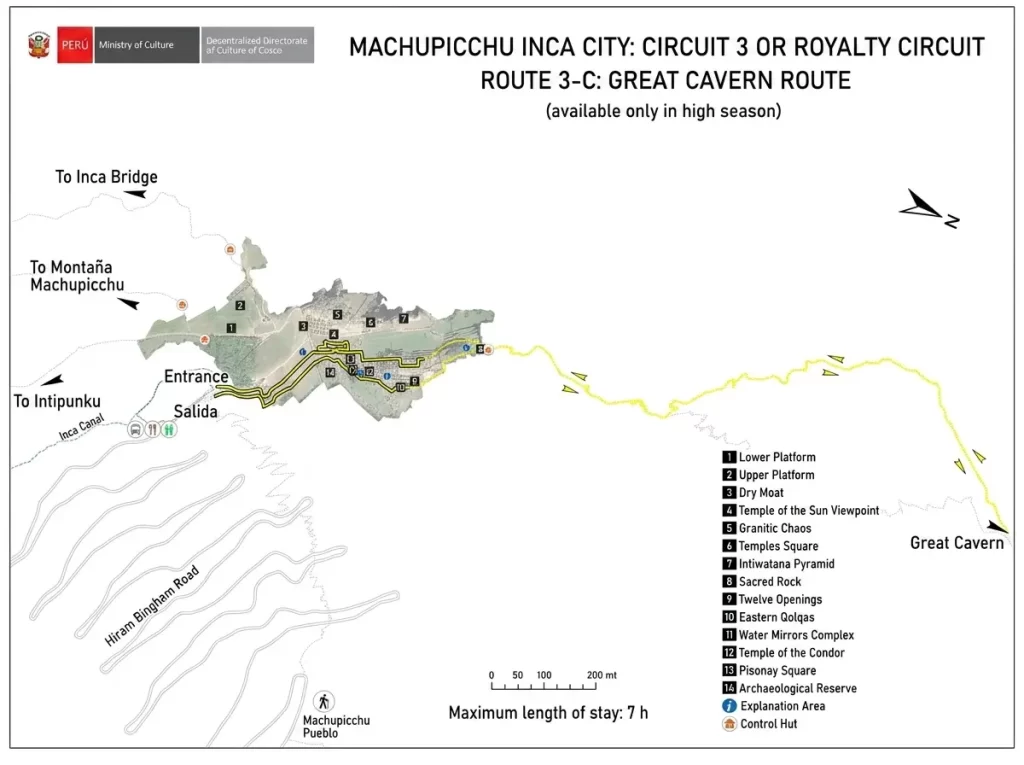
Route 3-C leads to the Great Cavern, one of the most distinctive hiking experiences within Circuit 3.
This route is traditionally known among many travelers as the Temple of the Moon route, although the official name currently used for the route is Great Cavern.
The trail passes through a lush mountain environment before reaching a structure located within a natural cave.
What does Route 3-C offer?
Its main attraction is the combination of:
- A visit to archaeological areas of Machupicchu.
- A mountain hike.
- Lush cloud-forest vegetation.
- A visit to the Great Cavern.
- An experience that differs from the conventional citadel routes.
The Great Cavern stands out because of the way Inca architecture was integrated with a natural rock formation.
Difficulty
High.
The route requires more physical effort than Route 3-B because of its length, elevation changes and trail conditions.
It is therefore best suited to travelers who are comfortable hiking on mountain terrain.
Maximum visiting time
The maximum visiting time established for Route 3-C is 7 hours.
This is the maximum time for the complete route experience and does not mean that visitors are required to stay for seven hours.
Availability
Route 3-C is one of the routes available during the high season, so its availability depends on the official calendar and the corresponding ticket quotas.
For 2026, the high-demand season established by Peru’s Ministry of Culture primarily covers June 19 through November 2.
Before purchasing your ticket, check the exact availability for your travel date.
Who is it recommended for?
It is a good option for:
- Travelers who enjoy hiking.
- Visitors looking for a less conventional Machu Picchu experience.
- People who want to visit the Great Cavern.
- Travelers interested in combining nature and archaeology.
7. Route 3-D: Huchuypicchu Mountain
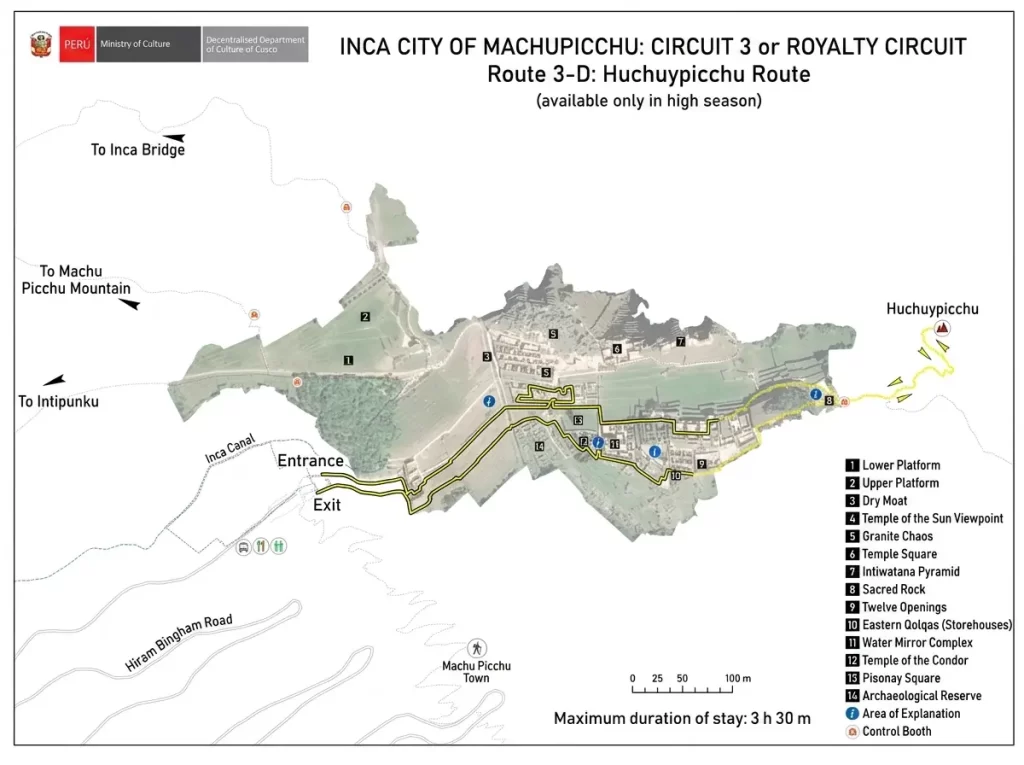
Route 3-D includes the ascent of Huchuypicchu Mountain.
Huchuypicchu is located next to Waynapicchu and offers a mountain experience that is shorter and less demanding than the ascent of Waynapicchu.
What does Route 3-D offer?
The main attraction is the hike to Huchuypicchu and the panoramic views of Machupicchu from the mountain.
Although the climb is shorter than Waynapicchu, visitors still need to navigate trails with stairs and elevation changes.
Difficulty
Moderate.
It is less demanding than Waynapicchu, but it should not be considered an entirely easy hike.
Trail conditions, humidity and elevation gain can increase the physical effort required.
Maximum visiting time
The maximum visiting time established for Route 3-D is 3 hours and 30 minutes.
Availability
Route 3-D is available during the high season according to the official calendar and ticket quotas.
For 2026, check the availability corresponding to your exact travel date before purchasing your ticket.
Who is it recommended for?
It can be a good option for:
- Travelers who want to add a mountain hike to their Machu Picchu visit.
- People who consider Waynapicchu too demanding.
- Visitors looking for panoramic views from a mountain.
- Travelers who want a different experience from Route 3-B.
8. Comparison of the 4 Machu Picchu Circuit 3 Routes
| Route | Main Experience | Maximum Visiting Time | Difficulty | Availability |
|---|---|---|---|---|
| 3-A | Waynapicchu Mountain | Up to 6 hours | High | According to schedules and quotas |
| 3-B | Designed Route | 2 h 30 min | Low-Moderate | Regular route |
| 3-C | Great Cavern | Up to 7 hours | High | High season |
| 3-D | Huchuypicchu Mountain | 3 h 30 min | Moderate | High season |
Important: the times shown above refer to the maximum visiting time established for each experience. They should not be interpreted as the exact amount of time every visitor will spend hiking.
9. Machu Picchu Circuit 3 Schedules and Visiting Times
There is no single schedule that applies identically to all four Circuit 3 routes.
Mountain routes have specific entry schedules and controls, while the routes designed for visiting the citadel have their own maximum visiting times.
For this reason, when purchasing your ticket, check:
- The exact name of the route.
- The visit date.
- The assigned entry time or group.
- The maximum visiting time.
- The specific conditions of the route.
Why is choosing the correct route important?
Because purchasing a general Machu Picchu admission does not mean you can freely switch between the four Circuit 3 routes.
The route indicated on your ticket determines the itinerary you can follow.
If you want to climb Waynapicchu, you need the specific Route 3-A ticket.
If you want to climb Huchuypicchu, you need Route 3-D.
And if you want to visit the Great Cavern, you need to select Route 3-C when available.
10. Which Machu Picchu Circuit 3 Route Should You Choose?
The best route depends mainly on what you want to experience during your visit.
Choose Route 3-A if you want to climb Waynapicchu
This is the right option if your main goal is to experience one of Machu Picchu’s most famous mountains.
Ideal for: active travelers, mountain enthusiasts and visitors who specifically want to climb Waynapicchu.
Choose Route 3-B if you prefer a relaxed visit
This is the most convenient option if you do not want a mountain hike and prefer to focus on the architecture and archaeological spaces.
Ideal for: families, travelers with limited time and visitors looking for a less demanding route.
Choose Route 3-C if you want to visit the Great Cavern
This is the option for travelers looking for a longer and more unusual hiking experience combining archaeology, nature and mountain scenery.
Ideal for: hikers and visitors who want to explore the Great Cavern.
Choose Route 3-D if you want a less demanding mountain experience
Huchuypicchu allows you to add a mountain experience without taking on the same climb as Waynapicchu.
Ideal for: travelers looking for panoramic views and a moderate hiking experience.
11. Circuit 3 vs. Circuit 2: Which Is Better?
One of the most common questions is whether Machu Picchu Circuit 3 or Circuit 2 is better.
The answer depends on what you want to do.
Circuit 3
It is a good option if you want to:
- Climb Waynapicchu.
- Climb Huchuypicchu.
- Visit the Great Cavern.
- Explore areas associated with the Royalty Circuit.
- Add a mountain hiking experience.
Circuit 2
It is a better alternative if your priority is to explore a broader selection of Machupicchu’s main archaeological sectors and have a more comprehensive experience of the citadel.
What if I want the classic Machu Picchu photo?
If your main priority is obtaining the traditional panoramic view of Machu Picchu from the upper part of the site, you should review the options available within Circuit 1.
For this reason, do not choose your ticket based only on the circuit number. First decide what type of experience you want.
12. Tips for Visiting Machu Picchu Circuit 3
1. Book in advance if you want a mountain route
Waynapicchu, Huchuypicchu and the Great Cavern have different quotas and availability conditions.
If you have a specific route in mind, do not wait until the last minute to purchase your ticket.
2. Check the route before paying
Carefully review the exact experience you are purchasing.
These are different options:
3-A → Waynapicchu
3-B → Designed Route
3-C → Great Cavern
3-D → Huchuypicchu
3. Do not confuse Circuit 3 with the panoramic route
If your main goal is to photograph Machu Picchu from the traditional upper viewpoints, review the Circuit 1 options before purchasing your ticket.
4. Wear appropriate footwear
Machu Picchu’s routes include stone surfaces, stairs and sections that can become wet.
Wear comfortable footwear with good grip.
5. Consider your physical condition
Waynapicchu and the Great Cavern require more physical effort.
Do not choose a mountain route simply because it is popular. Select the experience that matches your physical ability and the type of visit you want.
6. Check the official calendar
High-season routes, particularly 3-C and 3-D, are not available throughout the entire year.
Always check the calendar corresponding to the year of your visit.
7. Respect your entry schedule
Tickets are associated with specific entry times and conditions. Arrive early at the designated checkpoints and follow the instructions of the archaeological site’s staff.
13. Frequently Asked Questions About Machu Picchu Circuit 3
What is Machu Picchu Circuit 3?
Circuit 3, officially called the Royalty Circuit, is one of the three main visitor circuits at Machupicchu. It has four routes: 3-A Waynapicchu, 3-B Designed Route, 3-C Great Cavern and 3-D Huchuypicchu.
What is Machu Picchu Route 3-A?
Route 3-A combines the visit to Machupicchu with the ascent of Waynapicchu Mountain. It is a high-difficulty route and requires the specific ticket that includes this experience.
What is Route 3-B?
Route 3-B is the Designed Route within the Royalty Circuit. It does not include an additional mountain hike and focuses on different archaeological sectors of Machupicchu.
What is Route 3-C?
Route 3-C is the Great Cavern Route, traditionally known by many travelers as the Temple of the Moon route. It includes a mountain hike and is available during high season according to the official calendar.
What is Route 3-D?
Route 3-D includes the ascent of Huchuypicchu Mountain. It offers a less demanding mountain experience than Waynapicchu, although it still includes elevation changes and stairs.
Which is the most difficult Circuit 3 route?
Difficulty varies depending on each visitor’s physical condition, but Waynapicchu and the Great Cavern require more physical effort than Route 3-B. Huchuypicchu offers a moderate hiking experience.
Does Circuit 3 include the classic Machu Picchu photo?
You should not choose Circuit 3 specifically for the classic panoramic view of Machu Picchu from the upper part of the site. For that experience, review the options available in Circuit 1.
Does Circuit 3 include Huayna Picchu?
Yes, but only through Route 3-A, which includes the ascent of Waynapicchu.
Does Circuit 3 include Huchuy Picchu?
Yes. Access to Huchuypicchu corresponds to Route 3-D.
Is the Great Cavern part of Circuit 3?
Yes. The Great Cavern corresponds to Route 3-C of Circuit 3.
Which is the best Circuit 3 route?
There is no single route that is best for everyone. If you want a famous mountain, choose 3-A; if you prefer a relaxed archaeological visit, choose 3-B; if you want to visit the Great Cavern, choose 3-C; and if you want a moderate mountain hike, consider 3-D.
Our Final Recommendation
Machu Picchu Circuit 3 is an excellent option for travelers who want to combine an archaeological visit with different mountain experiences.
Your choice mainly depends on your priority:
Waynapicchu → Route 3-A
Relaxed archaeological visit → Route 3-B
Great Cavern → Route 3-C
Huchuypicchu → Route 3-D
Before booking, always check the exact route, entry schedule, availability and current conditions for your travel date.
If you already know that you want to climb Waynapicchu, Huchuypicchu or visit the Great Cavern, planning your ticket purchase in advance is especially important because these experiences have specific quotas and availability conditions.
At Machupicchu Luna Tours, we can help you determine which route best suits your trip and organize your Machu Picchu visit according to current availability.

