


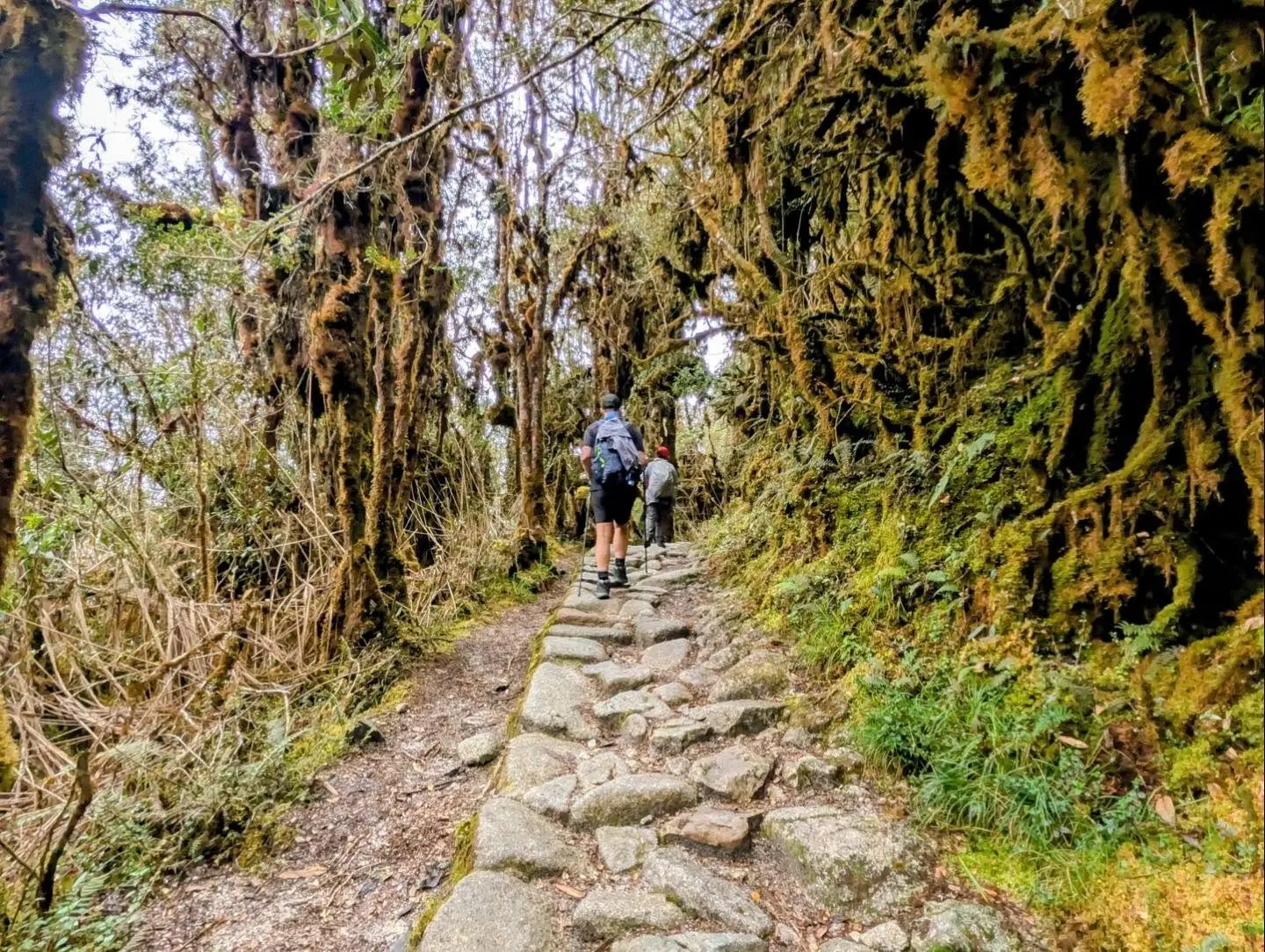
The 4-day, 3-night Inca Trail is one of the most famous trekking routes to Machu Picchu. The classic route traditionally begins at Piscacucho, at Km 82, and crosses ancient stone paths, archaeological sites, mountain passes, and cloud forests before reaching Machu Picchu through Intipunku, the Sun Gate.
But there is something important to understand before booking it:
The Inca Trail is not an easy hike.
Over four days, you will walk for several hours each day, deal with significant elevation changes, and cross Warmiwañusca Pass at 4,215 m (13,829 ft), the highest point of the classic Inca Trail.
In this guide, we explain what to expect each day, how the landscape changes along the route, where the main campsites are located, and what you should consider before preparing for your Inca Trail trek in 2026.
Before You Start: What You Need to Know
The Classic 4-Day Inca Trail is part of the Inca Trail Network within the Historic Sanctuary of Machupicchu.
The traditional route begins at Piscacucho, commonly known as Km 82, and continues through areas such as Wayllabamba, Warmiwañusca Pass, Pacaymayo, Runkurakay, Sayacmarca, Phuyupatamarca, Wiñay Wayna and Intipunku before reaching Machu Picchu.
These archaeological sites and sections of the route form part of the historic Inca road network associated with Machu Picchu.
How many people can enter the Inca Trail?
Access to the Inca Trail is regulated and requires advance booking through an authorized operator.
The official MINCETUR information establishes a maximum of 500 people per day, including visitors and support personnel.
Because the number of spaces is limited, you should not wait until you arrive in Cusco to look for availability if you already have specific travel dates.
Booking several months in advance is strongly recommended, especially for periods of high demand.
Is the Inca Trail closed in February?
Yes.
The Inca Trail Network closes every February for maintenance, conservation and evaluation work.
In 2026, the Inca Trail was closed throughout February and officially reopened on March 1, 2026.
Therefore, February is not an available month for hiking the Classic Inca Trail.
Do you need an agency for the Inca Trail?
Yes.
Access to the Inca Trail is regulated and requires an advance reservation and the corresponding permits. Visitors must use authorized tourism operators for this route.
This is different from some other trekking routes around Cusco, where independent hiking may be possible.
Day 1: Piscacucho (Km 82) to Wayllabamba
Distance: approximately 12 km (7.5 miles)
Hiking time: around 5–7 hours
Altitude: approximately 2,700 m (8,858 ft) at the starting point, rising to around 3,000 m (9,843 ft) at Wayllabamba
Difficulty: Moderate
The first day begins at Piscacucho, Km 82, the traditional starting point of the Classic Inca Trail.
From here, the trail initially follows the Vilcanota River before continuing into the Cusichaca Valley.
Compared with the following days, the elevation gain is generally more gradual.
One of the major highlights of this first day is Patallacta, one of the most important archaeological sites along the route. From the trail, you can see its extensive terraces and structures built along the mountainside.
The trail then continues through the Cusichaca Valley and gradually climbs toward Wayllabamba, where the first campsite is normally located.
What does Day 1 feel like?
For many hikers, the first day is an opportunity to settle into the rhythm of the trek.
That does not mean it is completely easy. You will still walk for several hours and encounter uphill sections, but the major challenge of the route is still ahead of you.
Tip: Don’t try to walk fast on the first day.
The Inca Trail is not a race, and you still have three days of trekking ahead.
Day 2: Wayllabamba to Warmiwañusca to Pacaymayo
Distance: approximately 11–12 km (6.8–7.5 miles)
Hiking time: around 7–8 hours
Maximum altitude: 4,215 m (13,829 ft)
Campsite: Pacaymayo, around 3,600 m (11,811 ft)
Difficulty: Hard
This is probably the day you will remember the most.
After leaving Wayllabamba, the trail begins a long ascent toward Warmiwañusca, commonly known as Dead Woman’s Pass.
At 4,215 m (13,829 ft), this is the highest point of the Classic Inca Trail.
The combination of elevation gain and altitude makes this the most physically demanding day for many hikers.
As you climb higher, the vegetation changes and the temperatures can become noticeably colder.
Eventually, you reach the pass.
For many hikers, reaching Warmiwañusca is one of the most satisfying moments of the entire trek. You have just completed the highest and one of the toughest sections of the route.
But the day is not over.
From the pass, the trail descends steeply into the Pacaymayo Valley, where the second campsite is located.
The most important thing about Day 2
Don’t focus on reaching the pass as quickly as possible.
A slow and consistent pace is usually much more useful than trying to keep up with faster hikers.
The descent should not be underestimated either.
After several hours of climbing, the stairs and uneven stone sections leading toward Pacaymayo can be hard on tired legs and knees.
Day 3: Pacaymayo to Runkurakay, Phuyupatamarca and Wiñay Wayna
Distance: approximately 16 km (10 miles)
Hiking time: around 8–9 hours, depending on pace and stops
Maximum altitude: approximately 3,950 m (12,959 ft)
Campsite: Wiñay Wayna, around 2,650 m (8,694 ft)
Difficulty: Moderate to Hard
The third day combines three of the things that make the Inca Trail so special:
mountains, archaeology and changing ecosystems.
After leaving Pacaymayo, the trail climbs again toward the second high point of the route, near Runkurakay, at approximately 3,900–3,950 m (12,795–12,959 ft).
From here, the trail enters a remarkable sequence of archaeological sites and original stone paths.
Some of the most important sites along this section include:
Runkurakay
Runkurakay is a semicircular Inca structure built in a strategic location along the trail.
Its position and design suggest that it played an important role within the Inca road system.
Sayacmarca
The name is commonly translated as “Inaccessible Town.”
The archaeological complex was built on a rocky location and features stairways, terraces, structures and water channels.
Phuyupatamarca
Often translated as “Town Above the Clouds,” Phuyupatamarca is one of the most impressive archaeological sites on the Inca Trail.
The complex includes terraces, structures and water fountains built into the mountainside.
Wiñay Wayna
After continuing along the trail and descending toward a greener and more humid environment, you eventually reach Wiñay Wayna, one of the most important archaeological complexes on the route.
The final campsite of the trek is located around 2,650 m (8,694 ft).
Why does Day 3 feel different?
Although this is one of the longest days, the constantly changing scenery makes the hike feel less repetitive.
You move from higher-altitude mountain environments into increasingly humid areas of cloud forest.
The vegetation becomes greener, and you may encounter orchids, bromeliads, ferns and different bird species along the route.
This combination of archaeological sites and changing landscapes is one of the main reasons many hikers consider Day 3 their favorite part of the Inca Trail.
Day 4: Wiñay Wayna to Intipunku and Machu Picchu
Distance: approximately 5 km (3.1 miles) to Machu Picchu, depending on the exact section measured
Hiking time: around 2–3 hours
Altitude: from approximately 2,650 m (8,694 ft) at Wiñay Wayna toward Machu Picchu
Difficulty: Moderate
The final day begins very early.
From Wiñay Wayna, you follow the final section of the Inca Trail toward Intipunku, also known as the Sun Gate.
This section is particularly special because Intipunku is the traditional point from which hikers approaching Machu Picchu along the Classic Inca Trail obtain their first major view of the citadel.
However, don’t expect guaranteed sunshine or a completely clear view.
Clouds, mist and weather conditions can change quickly in the mountains.
After passing through Intipunku, the trail continues toward the Machu Picchu archaeological site.
What happens after reaching Machu Picchu?
Once you reach the Machu Picchu area, your visit inside the archaeological site will follow the circuit and route assigned to your ticket.
This is important because the Inca Trail route and the Machu Picchu visitor circuits are not the same thing.
For 2026, the Ministry of Culture established the visitor route associated with entry through the Inca Trail within the current Machupicchu circuit system.
The Machu Picchu circuits have been reorganized into different routes, so the specific areas you visit inside the citadel depend on the ticket and route assigned to your reservation.
After your visit, you will normally continue to Machu Picchu Pueblo (Aguas Calientes) and then take the train according to the service included in your itinerary.
Inca Trail 4-Day Summary
| Day | Route | Approx. Distance | Key Altitude | Difficulty |
|---|---|---|---|---|
| 1 | Piscacucho (Km 82) → Wayllabamba | ~12 km / 7.5 mi | ~2,700 → 3,000 m / 8,858 → 9,843 ft | Moderate |
| 2 | Wayllabamba → Warmiwañusca → Pacaymayo | ~11–12 km / 6.8–7.5 mi | Up to 4,215 m / 13,829 ft | Hard |
| 3 | Pacaymayo → Runkurakay → Phuyupatamarca → Wiñay Wayna | ~16 km / 10 mi | Up to ~3,950 m / 12,959 ft | Moderate–Hard |
| 4 | Wiñay Wayna → Intipunku → Machu Picchu | ~5 km / 3.1 mi | ~2,650 m / 8,694 ft → Machu Picchu | Moderate |
Total distance: approximately 40–43 km (25–27 miles), depending on the exact points and sections used to measure the route.
Distances can vary slightly between sources and tour operators because certain access sections, detours and final approach sections may be measured differently.
How Difficult Is the 4-Day Inca Trail?
The 4-Day Inca Trail does not require technical mountaineering experience.
But that does not mean it is an easy hike.
The main challenge comes from the combination of:
- Several consecutive days of hiking.
- Significant elevation gains and losses.
- Long stone stairways.
- Uneven terrain.
- Altitudes above 4,000 m (13,123 ft).
- Camping overnight.
- Limited recovery time between hiking days.
Day 2 is generally the hardest, mainly because of the climb to Warmiwañusca at 4,215 m (13,829 ft).
Day 3 can also be exhausting because of its length and accumulated elevation changes.
Do you need to be an athlete?
No.
However, you should arrive with a reasonable level of fitness and enough time to acclimatize before beginning the trek.
Someone who is accustomed to walking for several hours and manages their pace well may have an easier time than someone with excellent cardiovascular fitness but no experience with long mountain hikes.
How to Prepare for the Inca Trail
You don’t need to train like a professional athlete.
The most useful preparation is to strengthen your legs, improve your endurance and become comfortable walking for several hours with elevation changes.
1. Walk regularly
In the weeks before your trip, combine brisk walking, stairs, cycling or other cardiovascular activities that you already practice.
2. Train on hills or stairs
If you have access to hills, mountains or long stairways, use them.
The Inca Trail includes numerous stone steps and elevation changes, so walking exclusively on flat terrain does not fully prepare you for the route.
3. Practice with long hikes
Before traveling to Peru, try several longer hikes.
This gives you an opportunity to see how your feet, legs and back respond after several hours of activity.
4. Break in your footwear
Never wear brand-new hiking boots or shoes for the first time on the Inca Trail.
Use your footwear beforehand to make sure it is comfortable and does not cause blisters or painful pressure points.
5. Acclimatize in Cusco
Arriving in Cusco before the trek gives your body time to gradually adjust to the altitude.
Acclimatization does not eliminate the risk of altitude illness, but it is an important consideration before undertaking a trek that reaches more than 4,000 m (13,123 ft).
If you develop significant symptoms related to altitude, tell your guide immediately and follow the instructions of the responsible medical or trekking personnel.
What to Pack for the Inca Trail
The amount of luggage you need depends on your tour and on which equipment is carried by your support team.
As a general starting point, consider bringing:
- Comfortable hiking shoes or boots that you have already used.
- Layered clothing.
- Waterproof jacket or rain poncho.
- Thermal clothing for cold nights.
- Hat or cap.
- Warm layers.
- Gloves.
- Sunscreen.
- Sunglasses.
- Insect repellent.
- Headlamp with spare batteries.
- Reusable water bottle or hydration system.
- Power bank.
- Personal hygiene products.
- Personal medications.
- Necessary travel documents.
- Trekking poles, if you are accustomed to using them.
- Sleeping bag, if it is not included in your tour.
Don’t carry an unnecessarily heavy backpack
Every extra kilogram becomes noticeable, especially during the climb toward Warmiwañusca.
Take only what you really need and check with your tour operator beforehand what equipment is included and how much additional luggage you can leave with the support team.
Tips for a Better Inca Trail Experience
1. Don’t try to race the Inca Trail
This trek is not a competition.
Walking too fast during the first few hours can leave you exhausted when you need your energy the most.
2. Save your energy for Day 2
The climb to Warmiwañusca is the major physical challenge of the route.
Starting Day 2 already exhausted can make the experience much harder.
3. Don’t underestimate the descents
After reaching Warmiwañusca, you still have a significant descent toward Pacaymayo.
The stairs and uneven stone surfaces can put considerable stress on your knees and legs.
4. Look around, not only at the trail
The Inca Trail is not simply a way to reach Machu Picchu.
Along the route, you will encounter archaeological remains, cloud forests, mountains, valleys and major changes in vegetation.
5. Listen to your guide
Your guide knows the route and can help you manage your pace, rest stops and the conditions of the trail.
6. Book well in advance
The number of spaces on the Inca Trail is limited.
MINCETUR establishes a maximum of 500 people per day, including visitors and support personnel.
If you have specific travel dates, especially during high-demand months, planning your reservation well in advance is strongly recommended.
7. Remember that trail conditions can change
The Inca Trail is exposed to rainfall, landslides and other natural conditions.
In August 2026, Routes 1, 2 and 3 of the Inca Trail Network were temporarily suspended following heavy rainfall and were reopened on August 26 after evaluation, rehabilitation and cleaning work.
For this reason, even if you have a confirmed reservation, it is always a good idea to check the latest official information before starting your trek.
Is the 4-Day Inca Trail Worth It?
If your only goal is to reach Machu Picchu, there are much faster ways to get there.
But if you want the journey itself to be an important part of your trip, the 4-Day Inca Trail offers something very different.
Over several days, you will walk along ancient stone paths, cross different ecosystems and visit archaeological sites such as Patallacta, Runkurakay, Sayacmarca, Phuyupatamarca and Wiñay Wayna before reaching Intipunku.
The experience also comes with a genuine physical challenge: several days of hiking and the climb to Warmiwañusca at 4,215 m (13,829 ft).
That is why the best way to approach the Inca Trail is not to think only about Machu Picchu.
Prepare yourself to enjoy the entire journey.
4-Day Inca Trail with Machupicchu Luna Tours
At Machupicchu Luna Tours, we organize the 4-Day, 3-Night Inca Trail for travelers who want to experience this historic route with a professional guide and organized logistics.
If you have less time available, you can also check our 2-Day, 1-Night Inca Trail.
If you already have an approximate travel date, contact us to ask about availability, the recommended preparation level and the equipment included in the tour.