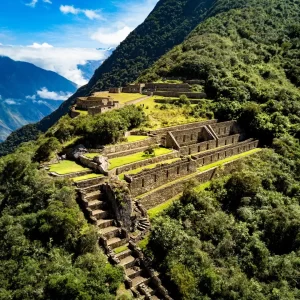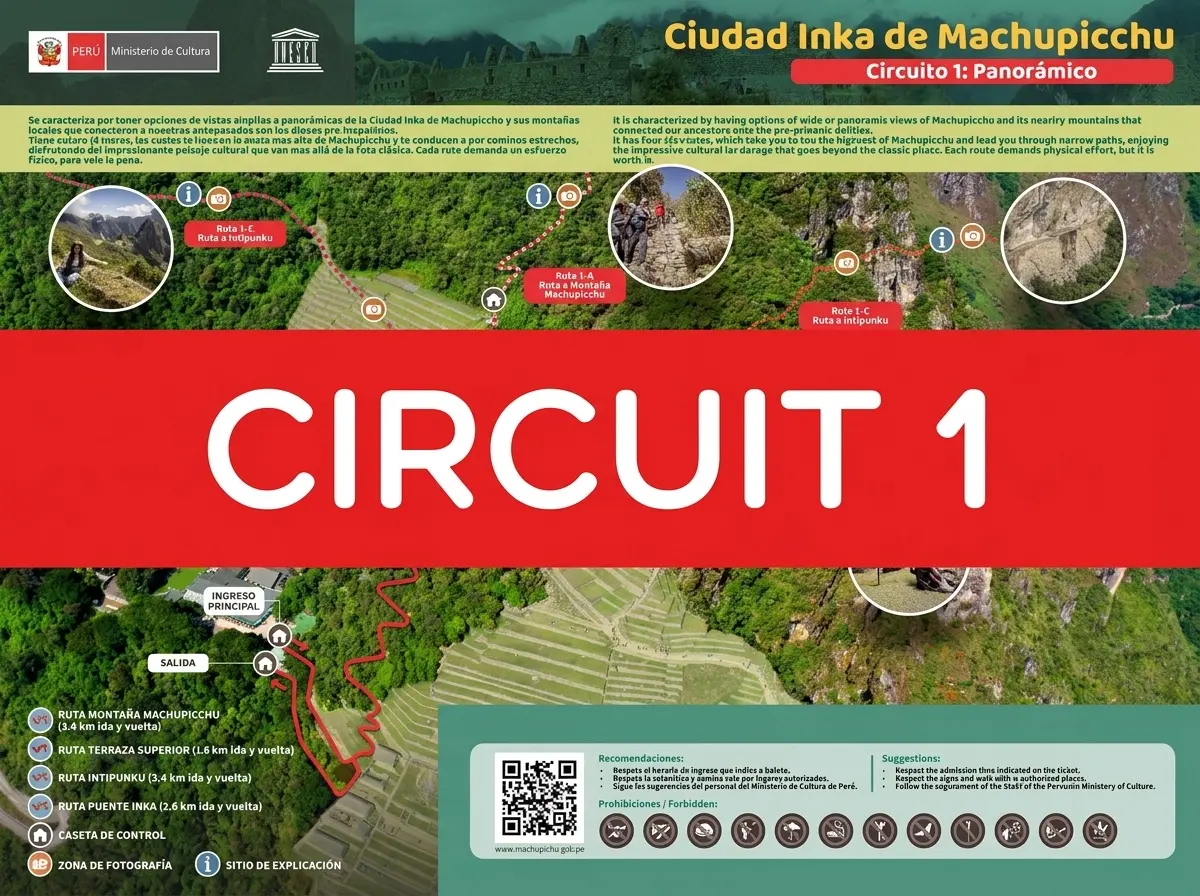
Machu Picchu Circuit 1, officially known as the Panoramic Circuit, is designed primarily for enjoying views of the Inca city, its terraces, and the mountainous landscape surrounding the archaeological site. It currently includes four different routes: 1-A Machupicchu Mountain, 1-B Upper Terrace, 1-C Intipunku Gate, and 1-D Inka Bridge. Routes 1-C and 1-D are available only during the high season established by Peru’s Ministry of Culture.
Choosing the right route is important because each one offers a different experience. Route 1-B is the simplest option for travelers mainly interested in panoramic views, while Route 1-A adds the ascent to Machupicchu Mountain. Routes 1-C and 1-D include additional hikes to Intipunku and the Inka Bridge, respectively.
In this guide, you will find the main differences between the four Machu Picchu Circuit 1 routes, including their characteristics, schedules, maximum visiting times, and recommendations to help you choose the best option for your trip in 2026.
1. What Is Machu Picchu Circuit 1?
Machu Picchu Circuit 1, officially called the Panoramic Circuit, is one of the three current visitor circuits established for exploring the Inca citadel of Machupicchu.
The current visitor system was introduced on June 1, 2024, reorganizing the visit into three circuits containing a total of ten routes. Circuit 1 consists of four routes:
- Route 1-A: Machupicchu Mountain
- Route 1-B: Upper Terrace
- Route 1-C: Intipunku Gate
- Route 1-D: Inka Bridge
Routes 1-C and 1-D are available only during high season.
Unlike Circuit 2, which focuses more extensively on the architectural sectors of Machu Picchu, Circuit 1 places greater emphasis on the upper terraces, viewpoints, and mountain landscapes surrounding the Inca city.
For this reason, it is particularly appealing to travelers interested in panoramic views, photography, and additional hiking experiences.
Does Circuit 1 allow you to enter Machu Picchu?
Yes. Circuit 1 is an official visitor circuit within the Machupicchu archaeological site.
However, the specific route listed on your ticket determines which areas and trails you can access.
You should not think of “Circuit 1” as a free route through the entire citadel. Each ticket corresponds to a specific route, and visitors must follow the designated path.
2. Route 1A: Machupicchu Mountain
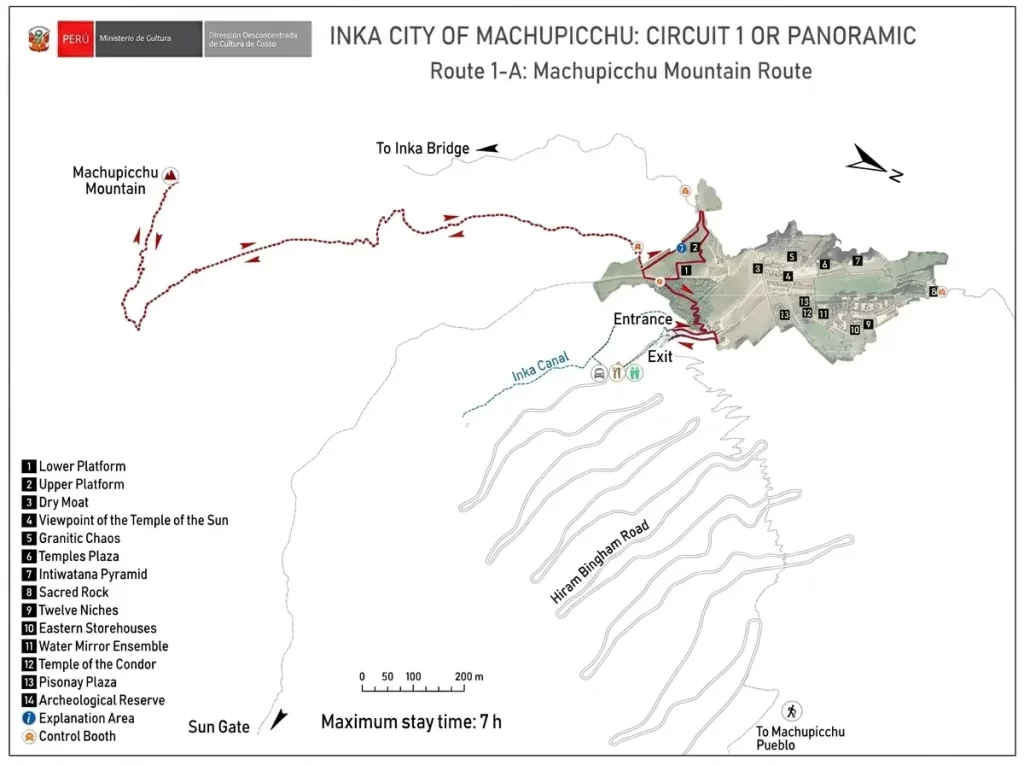
Route 1-A: Machupicchu Mountain combines the panoramic visit with a hike to the mountain that shares its name with the Inca citadel.
This is the Circuit 1 option requiring the greatest physical effort because it includes a sustained uphill hike through a mountain trail.
What does Route 1A offer?
The main attraction is the ascent toward Machupicchu Mountain, from where you can enjoy broad views of the landscape surrounding the archaeological site and the Historic Sanctuary of Machupicchu.
The experience is different from Huayna Picchu. Machupicchu Mountain reaches a higher elevation and provides a wider perspective of the surrounding landscape.
Difficulty
The difficulty can generally be considered moderate to demanding, depending on your fitness level, walking pace, and ability to adapt to altitude.
The trail does not require technical climbing skills, but it does involve sustained uphill sections and significant elevation changes.
For this reason, it is advisable to arrive well rested and allow yourself time to acclimatize before attempting the hike.
Visiting time
The official visitor regulations establish specific time limits for the route and subsequent time within the archaeological site. Therefore, it is not advisable to simply describe Route 1A as a “6-hour hike” without distinguishing the different stages of the visit.
The available time may depend on the entry schedule indicated on your ticket.
Who is Route 1A best for?
It is a good option for:
- Travelers who enjoy hiking.
- Visitors looking for panoramic views from a higher elevation.
- Photographers and landscape lovers.
- Travelers who want to combine Machu Picchu with an additional mountain hike.
- People with good physical fitness.
If your priority is walking less and enjoying a simpler visit, Route 1B may be a better choice.
3. Route 1B: Upper Terrace
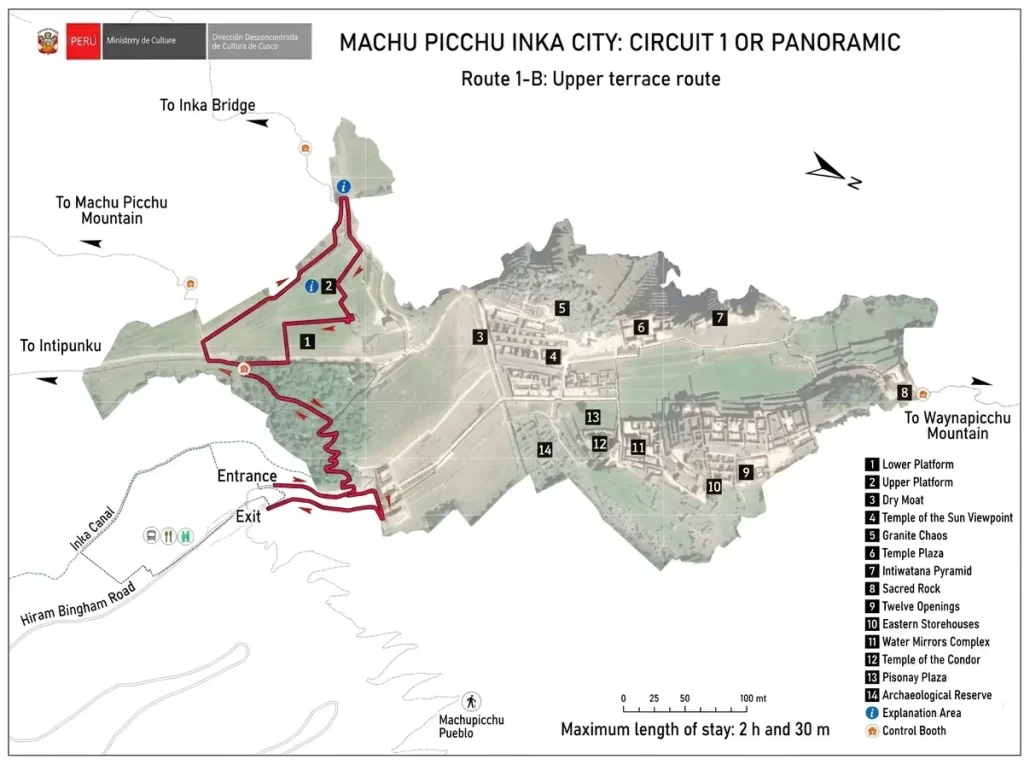
Route 1-B: Upper Terrace is one of the most convenient options for travelers who want to enjoy panoramic views of Machu Picchu without undertaking a mountain hike like the one included in Route 1A.
Its main attraction is the upper terraces and viewpoints offering some of the most recognizable views of the Inca city.
What does Route 1B offer?
The route allows visitors to enjoy the panoramic sector of Machu Picchu and the terraces overlooking the Inca city and the mountains surrounding it.
It is especially attractive for travelers with limited time, families, and visitors who prefer to minimize physical effort.
Difficulty
The difficulty is generally low, although the route still takes place in a mountain archaeological site, meaning there are stairs, uneven surfaces, and changes in elevation.
Is it the best route for the classic Machu Picchu photo?
Route 1B is one of the options for enjoying panoramic views and the upper areas of Machu Picchu.
However, the exact photograph you obtain will depend on weather conditions, the authorized viewpoint available during your visit, and instructions from site staff.
Who is Route 1B best for?
It is particularly suitable for:
- First-time visitors to Machu Picchu.
- Travelers with limited time.
- People who do not want to undertake a long hike.
- Families looking for an easier alternative.
- Photographers who prioritize panoramic views.
- Visitors who prefer not to climb a mountain.
If your main goal is to enjoy Machu Picchu without adding a demanding hike, this is one of the most practical options within Circuit 1.
4. Route 1C: Intipunku Gate
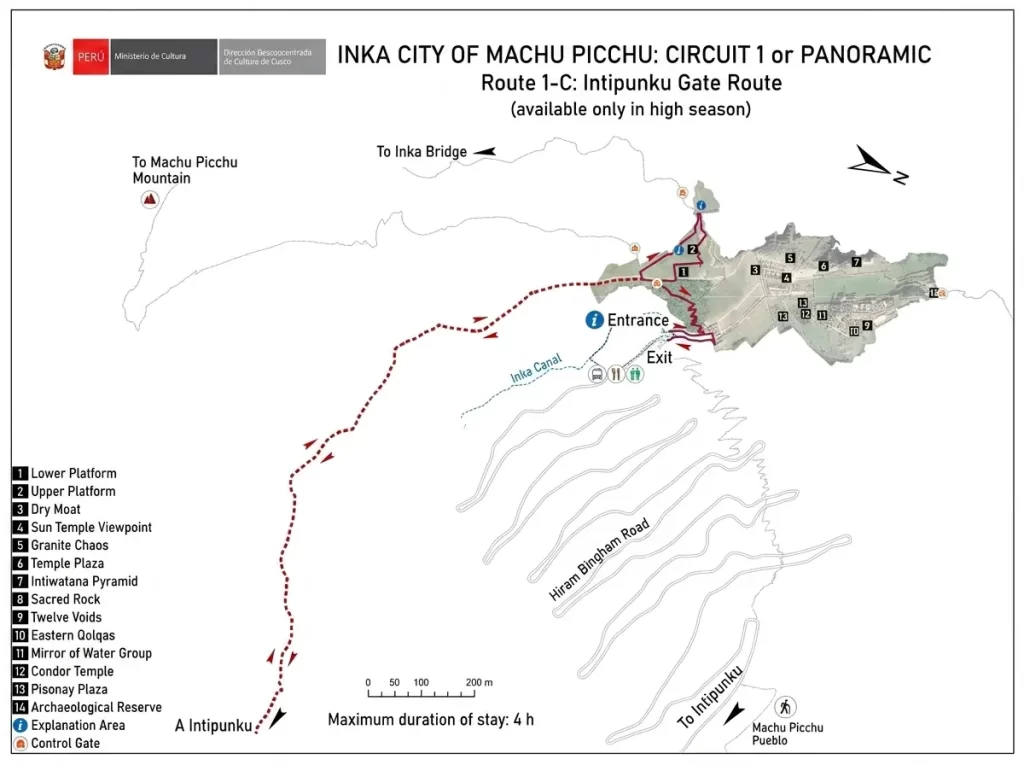
Route 1-C: Intipunku Gate includes a hike toward Intipunku, also known as the Sun Gate.
This route is available only during high season. The official Machupicchu website identifies Route 1-C as the “Intipunku Gate Route” and states that it is available exclusively during high season.
Intipunku has a special connection with the Inca Trail, as hikers arriving at Machu Picchu along this historic route pass through this area before continuing toward the Inca city.
What does Route 1C offer?
In addition to the panoramic experience of Circuit 1, this option allows visitors to hike toward Intipunku.
The trail provides a different experience from Route 1B because it includes an additional hike through a natural and archaeological environment.
Difficulty
The difficulty can generally be considered moderate, depending on your walking pace and physical condition.
It is not a technical trail, but it requires considerably more walking than a short panoramic visit.
Visiting time
The official route information establishes a maximum visiting time of 4 hours for Route 1-C.
Who is Route 1C best for?
It is a good choice for:
- Travelers who enjoy hiking.
- People interested in the Inca Trail.
- Visitors who want to see Intipunku.
- Landscape photographers.
- Travelers with enough time to complete the additional hike.
Important
Do not purchase Route 1C assuming that it will be available throughout the year. It is a high-season-only route, so you should check availability for your exact travel date before purchasing your ticket.
5. Route 1D: Inka Bridge
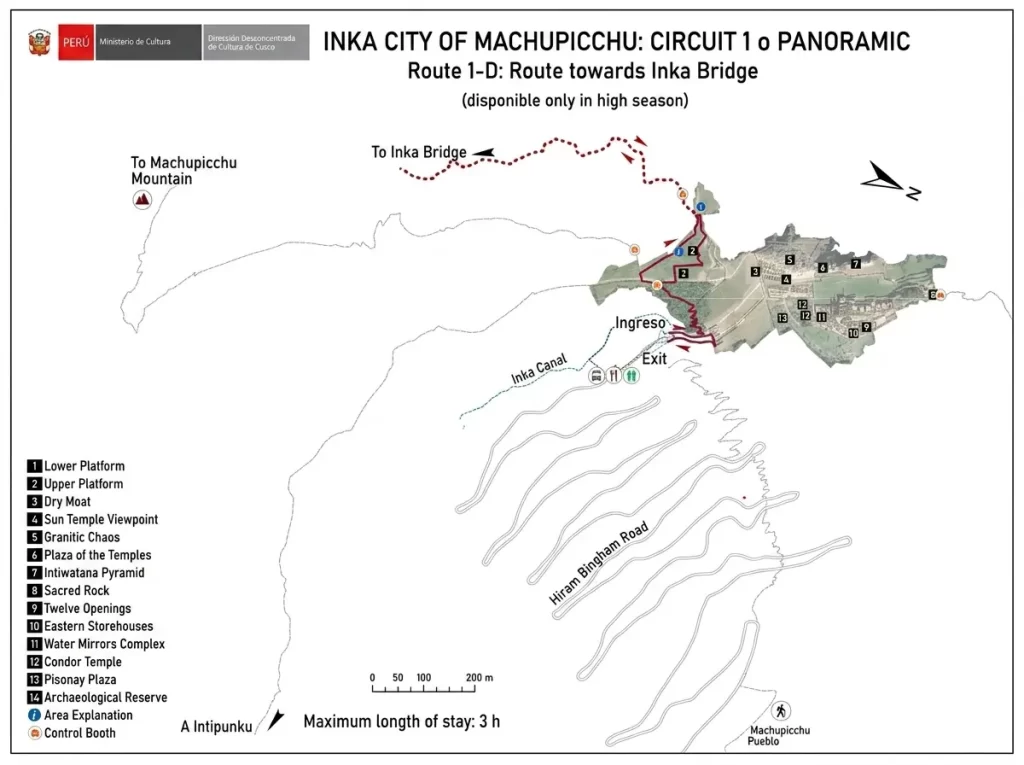
Route 1-D: Inka Bridge is another Circuit 1 route that operates only during high season.
Its main attraction is the trail toward the Inka Bridge, located in an area characterized by steep slopes and cliffs.
The official Circuit 1 information identifies this route as the “Inka Bridge Route” and establishes a maximum visiting time of 3 hours.
What does Route 1D offer?
The route allows visitors to reach the authorized viewpoint from which the Inka Bridge can be seen while enjoying a landscape characterized by steep slopes and vegetation.
The bridge forms part of the road system associated with Machu Picchu and is located in an area where the terrain requires particular attention.
Difficulty
The difficulty can generally be considered moderate, mainly because of the terrain, elevation changes, and exposed mountain environment.
It is not a route you should choose simply because it appears short. The characteristics of the trail mean that visitors should walk carefully and follow the instructions of site staff.
Visiting time
The maximum visiting time established for Route 1-D is 3 hours.
Can you cross the Inka Bridge?
You should not plan your visit expecting to cross the bridge.
The attraction of this route is reaching the authorized area from which the bridge can be observed while respecting the safety and conservation restrictions established for the archaeological site.
Who is Route 1D best for?
It may be interesting for:
- Travelers looking for a different experience.
- People interested in Inca roads and structures.
- Photographers looking for less conventional landscapes.
- Visitors who want an additional hiking experience during high season.
6. Comparison Table of the 4 Machu Picchu Circuit 1 Routes
| Route | Name | Main attraction | Physical effort | Availability |
|---|---|---|---|---|
| 1A | Machupicchu Mountain | Mountain hike and panoramic views from higher elevation | Moderate to demanding | Subject to ticket availability |
| 1B | Upper Terrace | Viewpoints and panoramic views of Machu Picchu | Low | Regular availability |
| 1C | Intipunku Gate | Hike to the Sun Gate | Moderate | High season only |
| 1D | Inka Bridge | Hike and views of the Inka Bridge | Moderate | High season only |
The official information confirms the four routes of Circuit 1 and specifies that Routes 1-C and 1-D are available only during high season.
Why don’t we include exact distances?
Distances published on tourism websites can vary depending on how the route is measured and do not always correspond to official figures.
For a guide focused on accurate information, it is better not to present exact kilometer figures as official data when they are not established that way by the Ministry of Culture.
7. Which Machu Picchu Circuit 1 Route Should You Choose?
The best route depends mainly on how much you want to walk and the type of experience you are looking for.
Choose Route 1A if…
You want to undertake a mountain hike and enjoy broad views from Machupicchu Mountain.
It is the most physically demanding option among the four routes.
Choose Route 1B if…
You want a simpler experience and your priority is enjoying the panoramic views of Machu Picchu.
It is particularly recommended if this is your first visit and you do not want to add a mountain hike.
Choose Route 1C if…
You are interested in Intipunku and the Inca Trail and are traveling on a date when this route is available.
It is a good alternative for visitors who enjoy hiking and want to explore a different sector.
Choose Route 1D if…
You are interested in visiting the area around the Inka Bridge and want an experience different from the standard panoramic visit.
Keep in mind that this route is also available only during high season.
Our recommendation
If this is your first visit and you want an easier experience focused on panoramic views, Route 1B is often the most practical choice.
If your priority is hiking and you want to add a physical challenge to your Machu Picchu visit, consider Route 1A.
There is no single route that is “best” for everyone. Your choice should depend on your available time, physical condition, and the type of experience you want at Machu Picchu.
8. What Does Machu Picchu Circuit 1 Include?
The exact route depends on the specific ticket you purchase.
The official Circuit 1 route information includes different areas and sectors such as:
- Lower Platform.
- Upper Platform.
- Dry Moat.
- Temple of the Sun viewpoint.
- Granite Chaos.
- Temple Plaza.
- Intiwatana Pyramid.
- Sacred Rock.
- Twelve Openings.
- Eastern Qolqas.
- Water Mirrors Complex.
- Temple of the Condor.
- Pisonay Plaza.
- Archaeological Reserve.
The exact areas accessible to you depend on the specific circuit and route indicated on your ticket.
For this reason, you should not assume that all four Circuit 1 routes provide exactly the same experience inside the archaeological site.
9. What Does Machu Picchu Circuit 1 NOT Include?
One of the most common questions is whether Circuit 1 allows visitors to explore the entire Machu Picchu citadel.
The answer is no.
The current visitor system divides Machu Picchu into different circuits and routes. Circuit 1 is the Panoramic Circuit, while Circuit 2 is the Classic Machupicchu Circuit and Circuit 3 is the Machupicchu Royalty Circuit.
Therefore, you should not purchase Circuit 1 expecting unrestricted access to every sector of Machu Picchu.
If your main goal is to explore more of the architectural spaces of the Inca city, compare Circuit 1 with the routes available under Circuit 2 before purchasing your ticket.
Does Circuit 1 include Huayna Picchu?
No.
The route to Huayna Picchu belongs to Circuit 3, Route 3-A: Waynapicchu Mountain.
Does Circuit 1 include Huchuy Picchu?
No.
The Huchuy Picchu route belongs to Circuit 3, Route 3-D, which is available during high season.
10. Machu Picchu High Season in 2026
This is particularly important if you are planning your trip to Machu Picchu in 2026.
According to Ministerial Resolution No. 285-2025-MC, certain dates in 2026 have a maximum capacity of 5,600 visitors per day at the Machupicchu archaeological site.
These dates are:
- January 1, 2026
- April 2–5, 2026
- June 19–November 2, 2026
- December 30–31, 2026
During these dates, the higher visitor-capacity regime established for 2026 applies.
This is particularly relevant for Circuit 1 routes that depend on high-season availability, such as 1-C Intipunku Gate and 1-D Inka Bridge.
What happens outside high season?
Routes 1-C and 1-D are not regularly available outside high season. The official Machupicchu website specifically identifies them as routes available only during high season.
Therefore, before purchasing your ticket, check the availability corresponding to your exact travel date.
11. Tips for Visiting Machu Picchu with Circuit 1
1. Buy your ticket in advance
Machu Picchu operates under a visitor-capacity system, and tickets are sold for specific routes and entry times.
For 2026, the Ministry of Culture established the official ticket sales system through the Tu Boleto platform.
If your travel dates are not flexible, especially during high season, it is advisable to organize your ticket purchase well in advance.
2. Check exactly which route you are purchasing
It is not enough to search for “Circuit 1.”
Check whether your ticket corresponds to:
- 1A Machupicchu Mountain.
- 1B Upper Terrace.
- 1C Intipunku Gate.
- 1D Inka Bridge.
Each route offers a different experience.
3. Consider your physical condition
If you are not used to hiking, Route 1B may be more appropriate than Route 1A.
For Machupicchu Mountain, you should be prepared to walk along a mountain trail with significant elevation changes.
4. Bring rain protection
The weather in Machu Picchu can change quickly.
Even during the dry season, it is advisable to bring:
- Rain poncho or waterproof jacket.
- Sunscreen.
- Hat or cap.
- Water.
- Appropriate footwear.
5. Do not confuse Machupicchu Mountain with Huayna Picchu
They are two different mountains.
Machupicchu Mountain corresponds to Route 1-A of the Panoramic Circuit.
Huayna Picchu corresponds to Route 3-A of the Machupicchu Royalty Circuit.
6. If you are hiking the Inca Trail, check your circuit separately
Do not assume that hiking the Inca Trail automatically means that you will have exactly the same route as a standard Circuit 1 ticket.
Access associated with the Inca Trail is subject to its own conditions and availability.
If you are hiking the Inca Trail and want to know which route you will follow when arriving at Machu Picchu, confirm the circuit included in your reservation.
12. Frequently Asked Questions About Machu Picchu Circuit 1
How many routes does Machu Picchu Circuit 1 have?
Machu Picchu Circuit 1, known as the Panoramic Circuit, has four routes: 1-A Machupicchu Mountain, 1-B Upper Terrace, 1-C Intipunku Gate, and 1-D Inka Bridge.
Which is the easiest route in Circuit 1?
Route 1-B Upper Terrace is the easiest option if you want to focus on panoramic views without undertaking a mountain hike.
Which is the most difficult route in Circuit 1?
Route 1-A Machupicchu Mountain requires the greatest physical effort because it includes the ascent to the mountain.
Does Circuit 1 include Huayna Picchu?
No. Huayna Picchu belongs to Route 3-A of Circuit 3: Machupicchu Royalty Circuit.
Does Circuit 1 include Intipunku?
Only if you purchase Route 1-C Intipunku Gate, which is available during high season.
Does Circuit 1 include the Inka Bridge?
Only Route 1-D Inka Bridge includes this route, and it is available during high season.
Can Machu Picchu Circuit 1 be visited year-round?
Availability depends on the route.
Routes 1-C Intipunku Gate and 1-D Inka Bridge are available only during high season. The other routes have different availability conditions.
Which Circuit 1 route is best for photography?
If your main goal is panoramic views without a demanding hike, Route 1-B Upper Terrace is a very convenient option.
If you prefer to combine photography with a mountain hike and views from a higher elevation, Route 1-A Machupicchu Mountain provides a different experience.
What is the difference between Circuit 1 and Circuit 2?
Circuit 1 is the Panoramic Circuit, focused primarily on viewpoints, terraces, and panoramic experiences.
Circuit 2 is the Classic Machupicchu Circuit, which offers a different route through the Inca city.
Therefore, your choice should depend on whether you prioritize panoramic views and hiking or a more extensive archaeological visit.
Our Final Recommendation
Machu Picchu Circuit 1 is an excellent option for travelers who want to enjoy panoramic views of the Inca city and the spectacular landscape of the Historic Sanctuary of Machupicchu.
However, the four routes are not the same.
Route 1A – Machupicchu Mountain: ideal if you want a demanding hike and panoramic views from a higher elevation.
Route 1B – Upper Terrace: recommended if you want a simpler experience focused on panoramic views.
Route 1C – Intipunku Gate: a good choice for travelers who want to hike to Intipunku during the dates when this route is available.
Route 1D – Inka Bridge: interesting for visitors who want to explore a different sector and enjoy a short hike in a mountain environment.
If this is your first visit and you want to minimize physical effort, Route 1B may be the most practical choice. If, on the other hand, you want your visit to include a mountain hike, Route 1A can provide a more active and panoramic experience.
Before purchasing your ticket, always check the route, date, and entry time available, since the Machu Picchu visitor system is regulated by Peru’s Ministry of Culture and conditions may vary depending on the season.
Discover our Machu Picchu Full-Day Tour – Circuit 1B Upper Terrace, designed for travelers who want to enjoy the panoramic Machu Picchu experience with a moderate amount of walking and without adding a mountain climb.
If you are unsure which route is best for your physical condition, travel date, or itinerary, we can help you choose the most suitable option.