


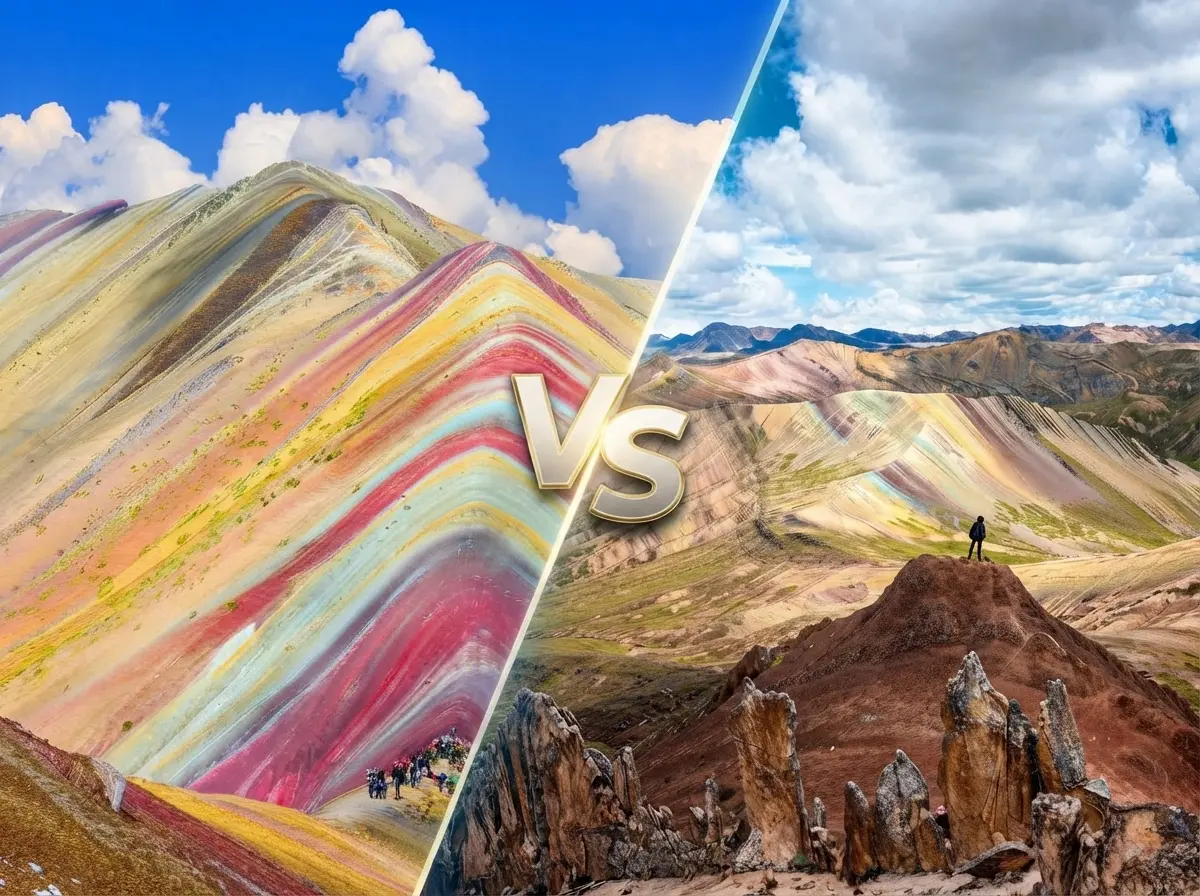
If you are planning a trip to Cusco, you have probably already seen photos of Vinicunca, the famous Rainbow Mountain. But you may have also come across another option: Palccoyo, a colorful mountain range with a shorter hike and a different type of scenery.
Although both destinations are located in the province of Canchis and form part of the high-Andean landscape of Cusco, the experience is not the same.
Vinicunca stands out for its iconic mountain and its altitude above 5,000 meters (16,400 ft). Palccoyo offers several colorful formations, the Stone Forest, and a generally shorter walking route.
In this guide, we compare altitude, hiking distance, difficulty, landscapes, crowds, season, and tour characteristics, so you can decide which experience fits your trip better.
Important: Hiking distances and times may vary depending on the access route, where the trail begins, weather conditions, and each traveler’s pace.
What is Rainbow Mountain (Vinicunca)?
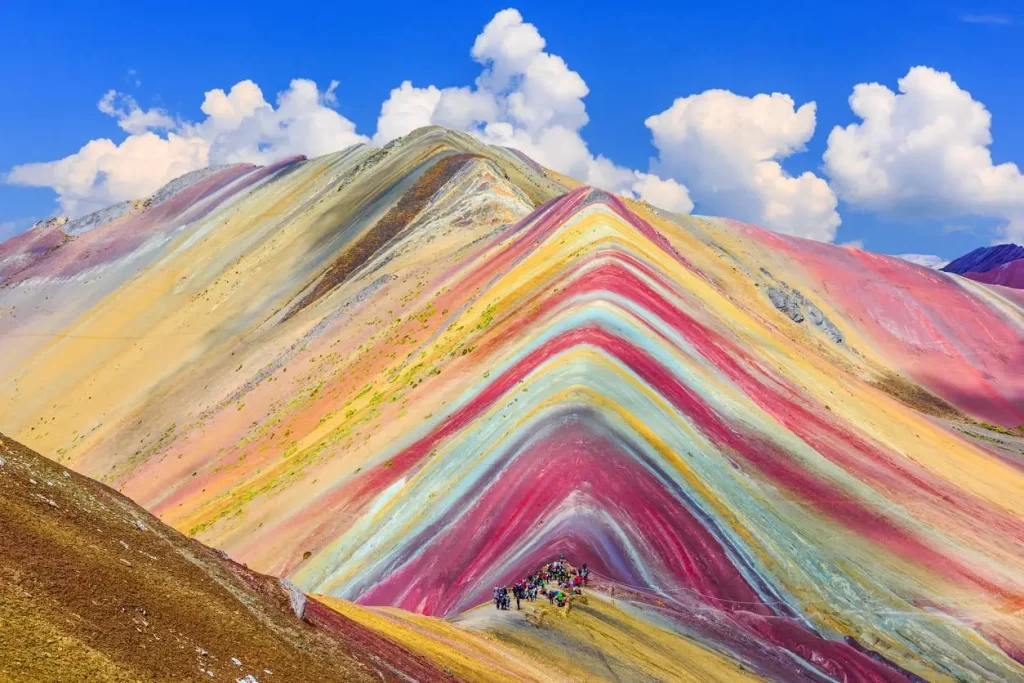
Vinicunca, also known as Winikunka, Rainbow Mountain, or the Mountain of Seven Colors, is a mountain formation in the Vilcanota mountain range in the province of Canchis, Cusco.
Peru’s Ministry of Foreign Trade and Tourism (MINCETUR) records Winikunka at 5,036 m (16,522 ft) above sea level, while the higher sections of the tourist route reach approximately 5,200 m (17,060 ft).
This is why different sources may give slightly different altitude figures.
The reddish, ochre, greenish, and other tones of the mountain are related to the composition of its sedimentary layers and minerals. Tectonic processes uplifted these materials, while erosion and oxidation contributed to the landscape visible today.
From the higher parts of the route, you can also enjoy views of Ausangate, one of the most important peaks in the Vilcanota mountain range.
Key facts about Vinicunca
- Location: Canchis Province, Cusco.
- Access: There are different tourist routes, including access through Cusipara/Cusipata and Pitumarca.
- Recorded altitude of the attraction: 5,036 m (16,522 ft).
- Altitude of higher sections of the route: approximately 5,200 m (17,060 ft).
- Main landscape: colorful mountain and panoramic views of the Vilcanota mountain range.
- Physical demand: high, mainly because of the altitude and elevation gain.
One important point is that there is no single hiking distance for every Vinicunca tour. The route you choose determines how far you will walk.
What is Palccoyo?
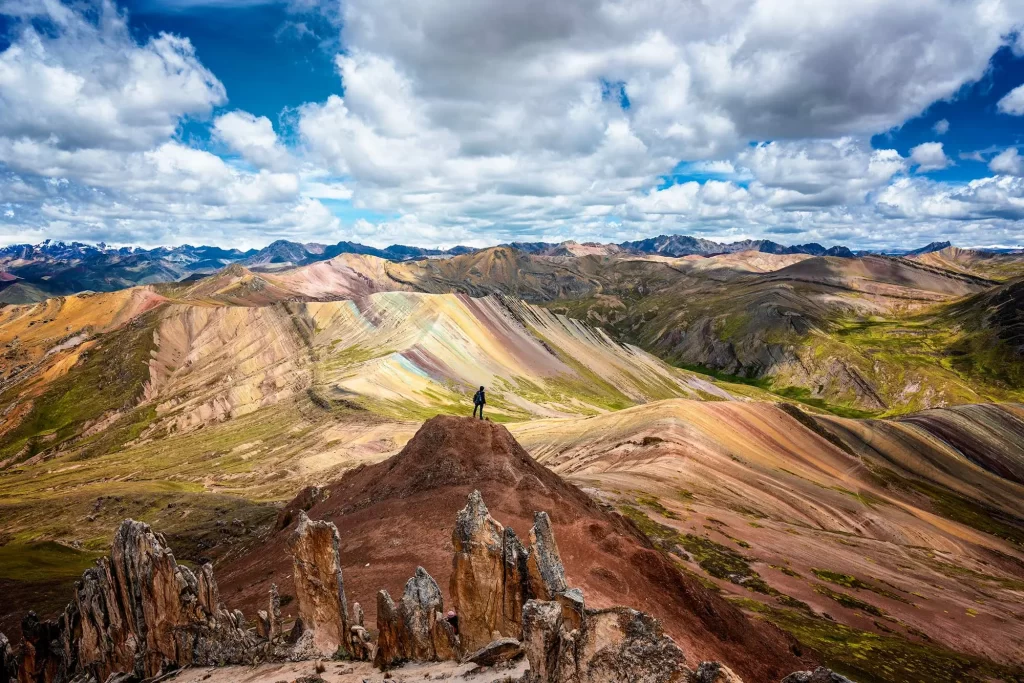
Palccoyo, also known as the Palccoyo Rainbow Mountain Range, is located in the district of Checacupe, Canchis Province, Cusco.
Unlike Vinicunca, Palccoyo is not centered around a single colorful mountain. From its viewpoints, you can see three colorful formations, as well as the well-known Stone Forest.
MINCETUR records the Palccoyo Rainbow Mountain Range at 4,787 m (15,705 ft) above sea level, while the higher tourist viewpoints are generally around 4,900 m (16,076 ft).
The vehicle reaches much closer to the tourist area than on the longer Vinicunca routes. However, this does not mean Palccoyo is a low-altitude destination: it is still close to 5,000 meters above sea level.
Key facts about Palccoyo
- Location: Checacupe District, Canchis Province, Cusco.
- Altitude recorded by MINCETUR: 4,787 m (15,705 ft).
- Higher sections of the route: approximately 4,900 m (16,076 ft).
- Landscapes: several colorful mountains, Stone Forest, and Andean scenery.
- Hiking difficulty: generally lower than Vinicunca.
- Hiking time: depends on the route and the traveler’s pace.
The area is also part of a high-Andean landscape with important cultural and natural value for local communities.
Vinicunca vs Palccoyo: Main Differences
Here is a quick comparison:
| Feature | Vinicunca | Palccoyo |
|---|---|---|
| Altitude of attraction / higher area | 5,036 m / up to approx. 5,200 m (16,522 / 17,060 ft) | 4,787 m / around 4,900 m (15,705 / 16,076 ft) |
| Location | Canchis, Cusco | Canchis, Cusco |
| Main landscape | One iconic colorful mountain | Several colorful formations |
| Stone Forest | Not the main attraction | Yes |
| Hiking | Depends on the access route | Generally shorter |
| Physical demand | High, especially because of altitude | Lower, although altitude remains significant |
| Popularity | Very high | Lower |
| Horses | Available on certain Vinicunca routes | Not commonly used |
| Main attraction | The classic Rainbow Mountain view | Variety of landscapes and a shorter route |
The most important difference is not simply which mountain has “more colors.” It is how you want to experience the destination and how your body responds to high altitude.
Altitude: Which One Is Higher?
This is one of the most important objective differences between the two destinations.
Vinicunca reaches a higher altitude than Palccoyo.
MINCETUR records Winikunka at 5,036 m (16,522 ft), while the higher section of the tourist route reaches approximately 5,200 m (17,060 ft).
At Palccoyo, MINCETUR records the Rainbow Mountain Range at 4,787 m (15,705 ft), while the higher tourist viewpoints are around 4,900 m (16,076 ft).
Therefore, the difference can approach 300 meters (984 ft) at the higher points.
| Vinicunca | Palccoyo | |
|---|---|---|
| Altitude recorded for the attraction | 5,036 m / 16,522 ft | 4,787 m / 15,705 ft |
| Higher area visited | ~5,200 m / 17,060 ft | ~4,900 m / 16,076 ft |
| Above 4,700 m / 15,420 ft? | Yes | Yes |
What does this mean for travelers?
You should not think of Palccoyo as a destination where altitude is not an issue.
Both routes are at very high elevations. The CDC notes that travelers ascending to high altitudes are at risk of altitude illness and recommends gradual ascent when possible.
Acclimatization also does not depend solely on physical fitness. Someone who exercises regularly can still experience altitude sickness, while another person with less training may tolerate altitude better.
Hiking Distance and Difficulty: Which One Is More Challenging?
This is where Palccoyo and Vinicunca differ considerably.
Vinicunca
The hiking distance depends on the route.
The traditional route through Pitumarca can involve a considerably longer hike, while the tourist route through Cusipata/Cusipara provides shorter access.
Current references describe routes of approximately 4 to 7 km (2.5 to 4.3 miles), depending on the starting point and the itinerary.
Hiking time also varies. Some itineraries estimate approximately 1 to 2 hours for the ascent, while other routes can require more time.
For this reason, it is not recommended to publish a single figure such as “2 hours” for every Vinicunca tour.
Palccoyo
The vehicle reaches much closer to the tourist viewpoints.
From the parking area, the main walk to the viewpoints generally takes around 45 minutes, although the total walking time increases if you visit additional attractions such as the Stone Forest.
The trail generally has more moderate slopes than the main Vinicunca routes.
So, is Palccoyo easy?
The hike may be shorter and less demanding, but the altitude remains the main challenge.
Walking at almost 4,900 meters is very different from taking a short hike at low altitude.
Therefore, “shorter hike” is a more accurate description than simply calling Palccoyo “easy.”
What Landscapes Will You See?
Vinicunca: The iconic view
Vinicunca is the mountain you have probably seen most often in photographs of Cusco.
Its main attraction is the colorful slope of the mountain, surrounded by the landscape of the Vilcanota range and, under favorable conditions, views toward Ausangate.
The experience is largely focused on reaching the viewpoint and seeing the formation that made this destination famous.
Palccoyo: More variety along the route
Palccoyo offers a different experience.
From its viewpoints, you can see three colorful mountain formations, as well as the Stone Forest, a group of natural rock formations.
You may also encounter llamas, alpacas, and other high-Andean wildlife in the surrounding area, although animal sightings are never guaranteed.
In short:
Vinicunca: one iconic mountain and a highly recognizable photograph.
Palccoyo: several colorful formations, the Stone Forest, and a different overall experience.
Which One Has More Tourists?
Vinicunca is the better-known destination of the two and therefore generally receives more visitors.
At certain times of day, people can gather around the viewpoint and the main photography areas.
Palccoyo generally receives fewer visitors and can offer a quieter experience.
However, it is better to avoid publishing specific daily visitor numbers unless you have an official and up-to-date record for the period being discussed.
Visitor numbers can change depending on:
- season;
- day of the week;
- weather;
- arrival time;
- route used;
- transportation availability.
If avoiding crowds is important to you, Palccoyo is an option worth considering.
Price and What the Tour Usually Includes
There is no single fixed price for a Vinicunca or Palccoyo tour.
The final cost depends on factors such as:
- shared or private transportation;
- type of vehicle;
- guide service;
- meals;
- entrance fees;
- group size;
- additional services;
- route used.
For that reason, instead of publishing a generic price that can quickly become outdated, it is better to confirm exactly what is included in each tour before booking.
What does an organized tour usually include?
Depending on the agency, a tour may include:
- hotel pickup;
- tourist transportation;
- breakfast;
- lunch;
- professional guide;
- entrance fee, when included in the service.
Entrance fees
Community entrance fees can change.
For example, updated 2026 information indicates that the Palccoyo entrance fee changed in June 2026.
If you are traveling in 2026, confirm the current entrance fee and whether it is included in your tour before making your reservation.
It is also a good idea to carry some Peruvian soles in cash for additional expenses.
Can you ride a horse at Vinicunca?
On certain Vinicunca access routes, horses and muleteers are available for part of the ascent.
This service is generally paid separately and does not necessarily eliminate the need to walk the final section to the viewpoint.
Best Time to Visit Vinicunca and Palccoyo
The dry season, approximately from April to October, generally offers more favorable conditions for visiting the colorful mountains, with a lower probability of rain and better chances of clear skies.
The rainy season usually occurs between November and March, although weather conditions can vary from year to year.
Do the colors disappear during the rainy season?
No.
The mountains retain their colors, but clouds, rain, snow, and moisture can significantly change how the landscape looks in photographs.
On cloudy days, the colors may appear less contrasted than under direct sunlight.
Is Palccoyo better during the rainy season?
It would not be accurate to say this as a general rule.
Its route may be shorter and have more moderate slopes, but mountain weather remains unpredictable and the altitude is still very high.
Your decision should consider both trail conditions and the weather forecast for the day of your visit.
Which One Should You Choose?
Choose Vinicunca if:
- you want to visit the most famous Rainbow Mountain;
- you are looking for the classic Vinicunca photograph;
- you are prepared for a more demanding hike;
- you want a more physically challenging mountain experience;
- you have had enough time to acclimatize before the excursion.
Consider Palccoyo if:
- you prefer a generally shorter hike;
- you want to see several colorful formations;
- you are interested in visiting the Stone Forest;
- you prefer a destination that is generally less crowded;
- you want an excursion involving less walking.
What if you are traveling with older adults or children?
Age alone should not determine the decision.
Both destinations are at considerable altitude, and people’s responses to high altitude vary.
If you are traveling with children, older adults, or anyone who is not accustomed to high altitude, consider their health, previous altitude experience, and acclimatization itinerary before booking.
If you have specific medical concerns, consult a healthcare professional beforehand.
Tips for Visiting Mountains Above 4,700 m (15,420 ft)
1. Do not underestimate the altitude
Both Vinicunca and Palccoyo are extremely high-altitude destinations for travelers arriving from sea level.
Being physically fit does not guarantee that you will avoid altitude sickness.
2. Acclimatize before going higher
When possible, ascend gradually and allow time to acclimatize in Cusco before visiting these mountains.
The CDC notes that the initial phase of acclimatization occurs mainly during the first few days after ascending.
3. Avoid alcohol before the excursion
The CDC recommends avoiding alcohol during the first 48 hours after arriving at high altitude.
4. Walk slowly
Do not try to maintain the pace of people who are already acclimatized.
On these routes, walking slowly and taking breaks can be much more important than trying to reach the viewpoint quickly.
5. Dress in layers
Mountain weather can change quickly from intense sunlight to cold temperatures and strong winds.
Bring:
- warm jacket;
- hat;
- gloves;
- thermal clothing if needed;
- rain protection;
- shoes with good traction.
6. Protect yourself from the sun
Ultraviolet radiation is strong at high altitude.
Bring:
- sunscreen;
- sunglasses;
- cap or hat.
7. Stay normally hydrated
Carry enough water and drink regularly.
There is no need to force yourself to consume excessive amounts of water. Adequate hydration should simply accompany your physical activity and the conditions of the trip.
8. Know the symptoms of altitude sickness
Headache, fatigue, dizziness, loss of appetite, nausea, or vomiting can occur after rapidly ascending to high altitude.
If symptoms worsen, do not continue ascending and seek medical assistance.
Severe cases require medical attention and descent to a lower altitude.
Frequently Asked Questions
Which is higher, Vinicunca or Palccoyo?
Vinicunca.
MINCETUR records Winikunka at 5,036 m (16,522 ft) above sea level, while the higher part of the route reaches approximately 5,200 m (17,060 ft). Palccoyo is around 4,800–4,900 m (15,748–16,076 ft), depending on the specific point being considered.
Which one has the shorter hike?
Generally, Palccoyo.
The vehicle reaches much closer to its viewpoints, so the main walking section is considerably shorter than on the more demanding Vinicunca routes.
Which one is more difficult?
Vinicunca is generally more physically demanding because of its higher altitude, elevation gain, and the characteristics of its different access routes. However, actual difficulty depends on the route and each traveler’s acclimatization.
Does Palccoyo have three colorful mountains?
Yes.
From the viewpoints of the Palccoyo Rainbow Mountain Range, visitors can see three colorful formations, as well as the Stone Forest.
Can you ride a horse at Vinicunca?
Certain Vinicunca access routes offer horse and muleteer services. These are generally paid separately and may not replace the final walking section to the viewpoint.
Which one has fewer tourists?
Palccoyo generally receives fewer visitors than Vinicunca, although visitor numbers vary according to the season, day, and arrival time.
Which one is better for someone who is not used to hiking?
Palccoyo generally involves less walking, but this does not remove the challenge of high altitude.
If you have never been at high altitude before, acclimatization should be an important consideration before either excursion.
Should I visit Vinicunca or Palccoyo?
It depends on what you are looking for.
If your priority is visiting the most famous Rainbow Mountain and getting the classic Vinicunca photograph, Vinicunca may fit your itinerary better.
If you prefer a shorter hike, several colorful formations, and the Stone Forest, Palccoyo may be an interesting alternative.
There is no universal choice. Your acclimatization, physical condition, weather, route, and the type of experience you want are more important than simply choosing the more famous destination.
Vinicunca or Palccoyo: Which One Fits Your Itinerary?
At Machupicchu Luna Tours, we offer both excursions because each one provides a different experience.
Vinicunca stands out for its iconic mountain, higher altitude, and the challenge presented by its different access routes.
Palccoyo offers a shorter walk to its viewpoints, several colorful formations, and the Stone Forest.
If you are still unsure which one fits your trip, we can help you compare the excursion with the rest of your Cusco itinerary, taking into account your acclimatization days, preferred hiking level, and group requirements.
Explore our Rainbow Mountain Vinicunca Tour or our Palccoyo Rainbow Mountain Tour and choose the experience that best fits your trip.